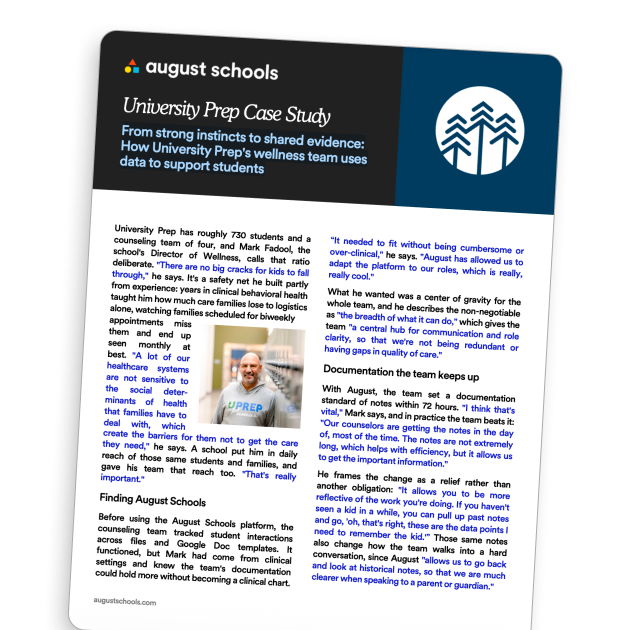
University Prep has roughly 730 students and a counseling team of four, and Mark Fadool, the school's Director of Wellness, calls that ratio deliberate. "There are no big cracks for kids to fall through," he says. It's a safety net he built partly from experience: years in clinical behavioral health taught him how much care families lose to logistics alone, watching families scheduled for biweekly appointments miss them and end up seen monthly at best. "A lot of our healthcare systems are not sensitive to the social determinants of health that families have to deal with, which create the barriers for them not to get the care they need," he says. A school put him in daily reach of those same students and families, and gave his team that reach too. "That's really important."

Before using the August Schools platform, the counseling team tracked student interactions across files and Google Doc templates. It functioned, but Mark had come from clinical settings and knew the team's documentation could hold more without becoming a clinical chart. “It needed to fit without being cumbersome or over-clinical," he says. "August has allowed us to adapt the platform to our roles, which is really, really cool." What he wanted was a center of gravity for the whole team, and he describes the non-negotiable as "the breadth of what it can do," which gives the team "a central hub for communication and role clarity, so that we're not being redundant or having gaps in quality of care."
With August, the team set a documentation standard of notes within 72 hours. "I think that's vital," Mark says, and in practice the team beats it: "Our counselors are getting the notes in the day of, most of the time. The notes are not extremely long, which helps with efficiency, but it allows us to get the important information." He frames the change as a relief rather than another obligation: "It allows you to be more reflective of the work you're doing. If you haven't seen a kid in a while, you can pull up past notes and go, 'oh, that's right, these are the data points I need to remember the kid.'” Those same notes also change how the team walks into a hard conversation, since August "allows us to go back and look at historical notes, so that we are much clearer when speaking to a parent or guardian."
The question that has defined Mark's career is not who walks into the counseling office, but who doesn't: "One thing I've always stressed is, who are we not seeing, and what do we need to do to change programming to be more accessible to the students we historically haven't reached?" In August, the count of encounters and their categories answers that question: "It gives you those data points." On the Analytics page in August, the team could see they were having a hard time getting young men in to a counselor. "There's the stigma," Mark says, and rather than accept it, "one of the counselors decided she was going to really focus her professional development on figuring out how to encourage young men in."
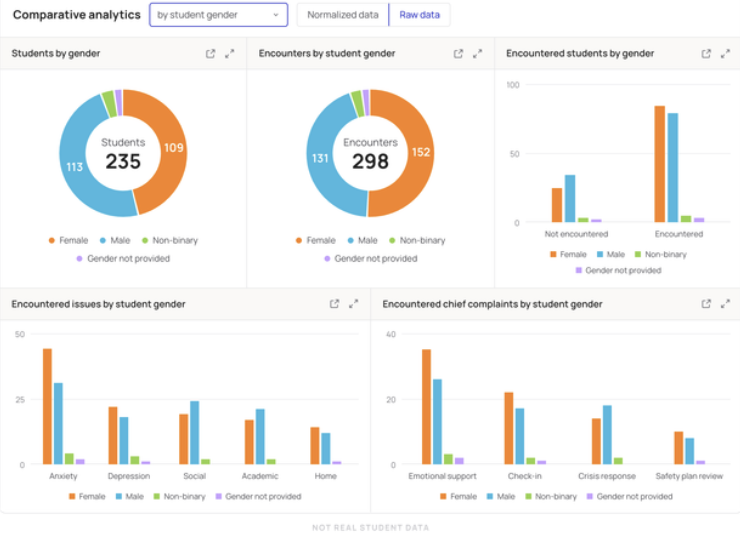
"We see a lot of kids with anxiety. We've known that, but looking at the numbers and the graphs, one of our counselors really focused on how to improve her work with students with high anxiety and perfectionism." That focus left the office. "What that meant was counselors doing presentations to faculty and to whole classes on how to deal with perfectionism in the classroom. August just amplified the areas we need to beef up our skills on."
August gave the team a record leadership could see. "It validates the good work the team's been doing for years," Mark says. "Now we have the data to show administration: this is how many kids we saw, this many encounters, these were the categories of the encounters." Because administrators are stretched thin, Mark uses August to bring the signal to them instead of asking them to dig for it. "What it does is it allows me to do summaries and snapshots of what I learned through August to share with them." He has shared those with the head of school, his supervisor, the parent guardian association, and the school's integrated learning team.
The rollout went more smoothly than Mark expected, though it started with reluctance, and the first concern was access. Who could read counseling notes August's controls answered it. "Once they were assured that August is tight, that we have total control over who can read them and who can't," the resistance eased. He led the rest patiently. "I gave them room to play with it. I brought it up at every meeting for a while, lovingly, not with a stick. When folks see a benefit from it, then it's their own."
What closed it was the product. "What sold the team on August was August," Mark says. "The platform is intuitive, and it let us be more reflective and have pride in the work." His goal for next year is to extend August beyond counseling into the school's other support teams, so one shared picture of a student follows everyone who works with that kid, for a reason that is the whole point: "It breaks down silos. And if we break down silos, we can provide better care. That's what we want to do."