For most of independent school history, enrollment conversations centered on outcomes. College placement records. AP offerings. Athletic championships. Faculty credentials. Schools competed on credentials, and families chose accordingly.
That calculus has shifted. Families are still interested in academic rigor. But the question they ask first has changed. Before they want to know where graduates go to college, they want to know something simpler: Will my child be okay here? Will someone notice if they are not?
A 2023 Edstart survey of 1,545 independent school parents found that 69% would switch schools if their child was unhappy or not well looked after, compared to just 20% who would switch for academic reputation alone.1
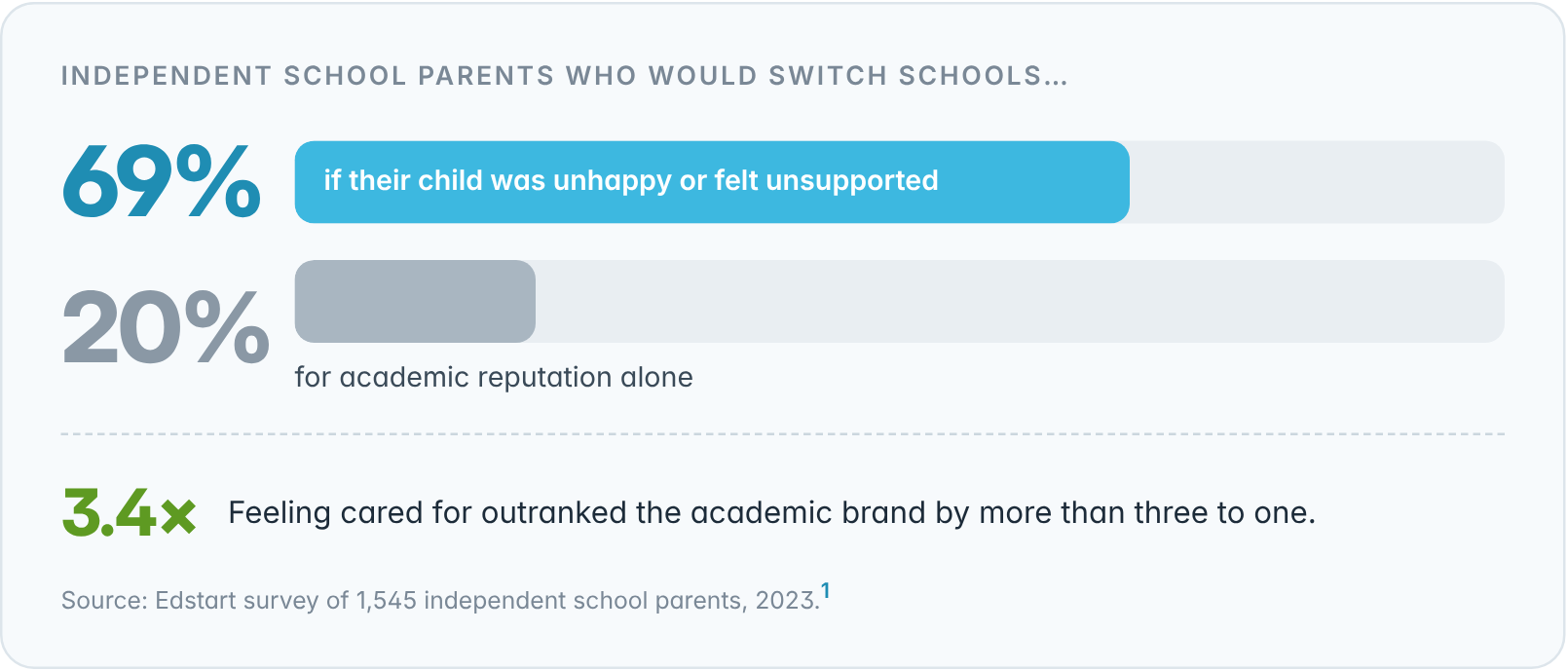
The thing most schools spend the most energy building and marketing, the academic brand, ranked behind feeling cared for by more than three to one. It is a structural shift in what families are purchasing when they choose an independent school.
The past decade has produced a sustained and significant deterioration in adolescent mental health, one that independent school families are watching in real time.2,3

When families choose a school, and when they decide whether to stay, trust in the school's ability to support their child is the primary variable. A school that can answer that question credibly, with visible systems and not just good intentions, holds a meaningful advantage.
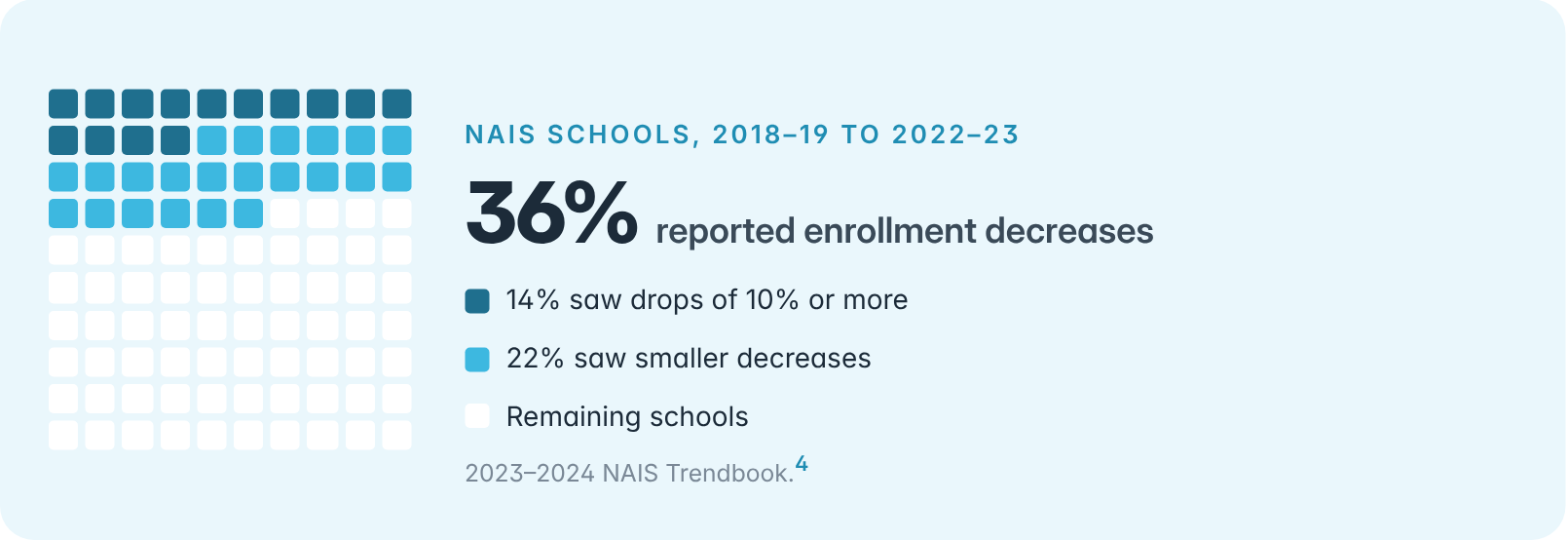
NAIS enrollment data reinforces the pattern. Between 2018–19 and 2022–23, 36% of NAIS schools reported enrollment decreases, including 14% that saw drops of 10% or more.4 The schools experiencing attrition were not necessarily weaker academically. They were often schools that had not made a visible, credible commitment to wellbeing at the program and infrastructure level.
Educators, counselors, learning specialists, deans, and advisors want to work in environments where their efforts actually reach students. Where a concern raised in one conversation travels to the right people. When that infrastructure is missing, even talented and committed staff begin to feel like they are doing heroic work with inadequate tools. Over time, they leave.
Caring and coordinating are two different things. Without the right infrastructure, even the most dedicated village is working with an incomplete picture.
Most independent schools have invested in counselors, learning specialists, advisors, nurses, and SEL programs. What many are missing is coordination.
The nurse picks up on stress signals. The counselor tracks social-emotional patterns. The learning specialist sees how anxiety affects focus. The advisor holds the family relationship. The classroom teacher sees the student every day. Each holds a piece of the picture, and in most schools those pieces stay in their silos. When a student moves from middle to upper school, the receiving team starts from scratch. When a family raises a concern, different adults are working from different versions of the story.
The result is support that families eventually feel. Not as a crisis, usually. As a slow accumulation of moments where their child was not quite seen.
Research on student persistence points to one consistent factor: whether a student has at least one trusted adult at school who knows her situation and shows up accordingly.5
Two schools share a market. Both are academically strong. One has spent decades building an academic reputation and has three counselors on staff. The other is known for happy students, a strong advisory program, and a school-wide emphasis on wellbeing. It has five counselors.
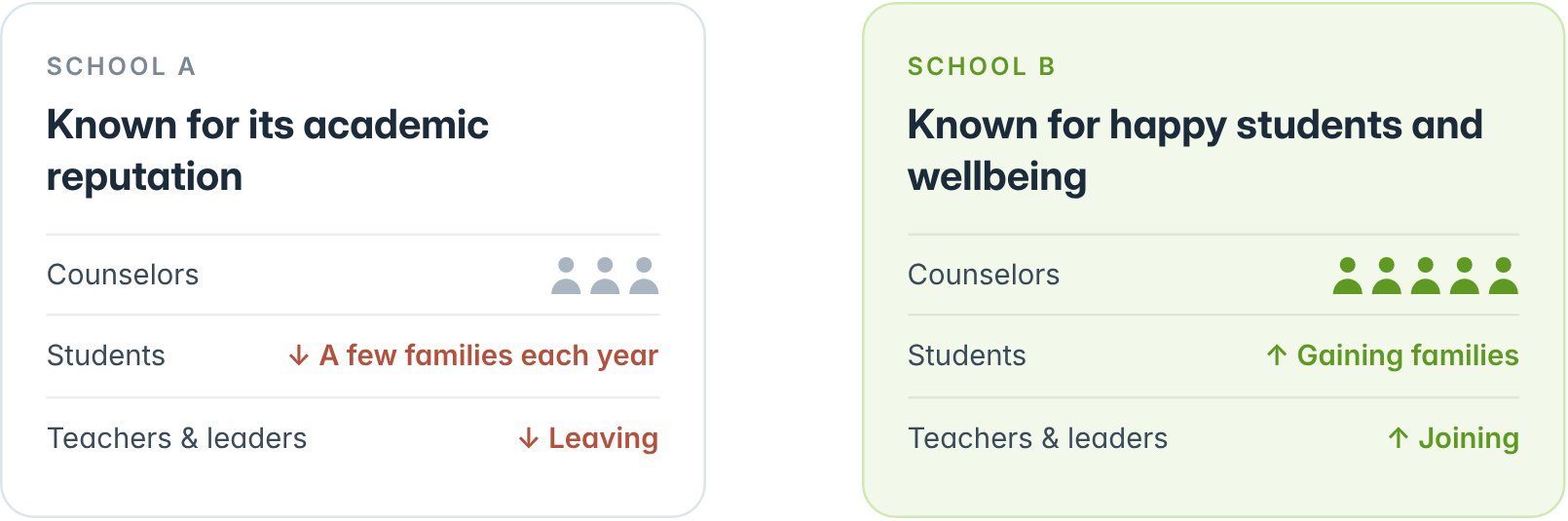
Over five years, the first school loses a few families each year. When the dean tracks where they go, the answer is almost always the same school. Teachers and leadership follow. Attrition looks like a retention problem long before anyone identifies it as a wellbeing problem.
Schools growing enrollment and retaining students share a set of operational practices that go beyond having the right people in place.
When a student sees the nurse for stress-related symptoms, that context is accessible to the counselor. No adult starts from scratch, and nothing depends on a hallway conversation to travel.
Every adult in the building is part of the early warning network. The coach who notices a student has been withdrawn has somewhere to put that observation, and it gets there fast.
When a student moves divisions or a caseload changes, the context travels with her. The receiving team knows the arc of support before they walk into a family conversation.
Attendance patterns, recurring health visits, and changes in engagement become visible at the school level, not just to the adult who happened to notice. Intervention happens before a crisis.
Leaders can speak to wellbeing outcomes with data, not anecdotes, in a board meeting or a parent conversation.
Wellbeing investment is often treated as a cost center. The economics tell a different story.
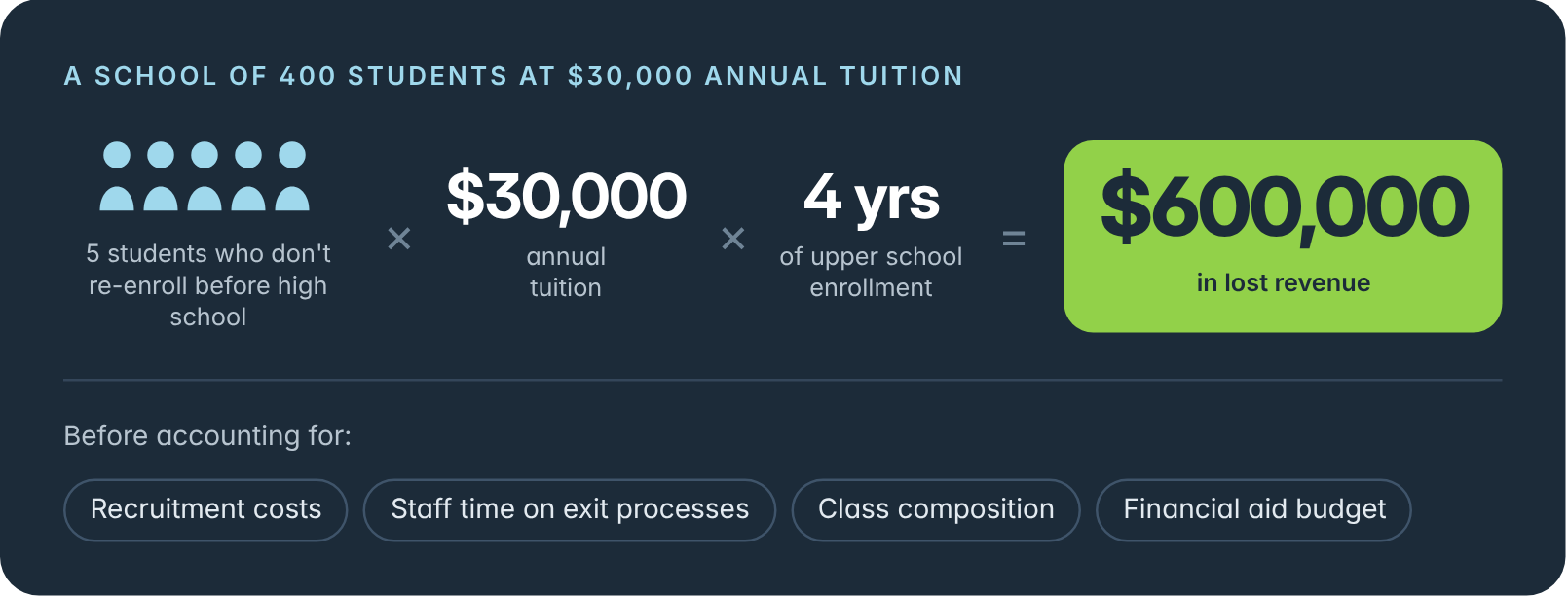
Families rarely cite academics when they leave an independent school. Exit interviews return the same themes.

Infrastructure that coordinates care across roles, surfaces early signals, and delivers a consistent family experience reduces attrition, generates word-of-mouth, and builds the reputation no marketing budget can buy.
Adolescent mental health challenges are not receding, and the shift in what families prioritize is structural. The schools best positioned to respond already believe in the whole child. What is often missing is the infrastructure to make that commitment visible and consistent, so the care a school's adults provide reaches every student, not just the ones who find their way to the right office.
That is a solvable operational problem. The schools that solve it first will hold a durable advantage in their markets for years to come.
Download the full white paper above for the complete research and sources.
1. Edstart. Survey of 1,545 independent school parents. 2023.
2. Centers for Disease Control and Prevention. Youth Risk Behavior Survey Data Summary & Trends Report: 2013–2023. 2024.
3. Ghandour RM, et al. Adolescent Mental and Behavioral Health, 2023. National Survey of Children's Health Data Brief. National Center for Health Statistics, October 2024.
4. Torres, Amada. "Enrollment Outlook." 2023–2024 NAIS Trendbook. National Association of Independent Schools, 2023.
5. National Association of Independent Schools. High School Survey of Student Engagement (HSSSE): 2024 Trends Report. Indiana University Center for Evaluation, Policy & Research, 2025.